Logging Made Easy: CISA releases swansong for accessible SIEM for the masses
Logging Made Easy shows that many organisations can get most of the practical SIEM outcome without handing their budget and engineering calendar to licence gravity. Its biggest weakness is not price. It is the licensing wall around turning it into a clean managed-service offer.
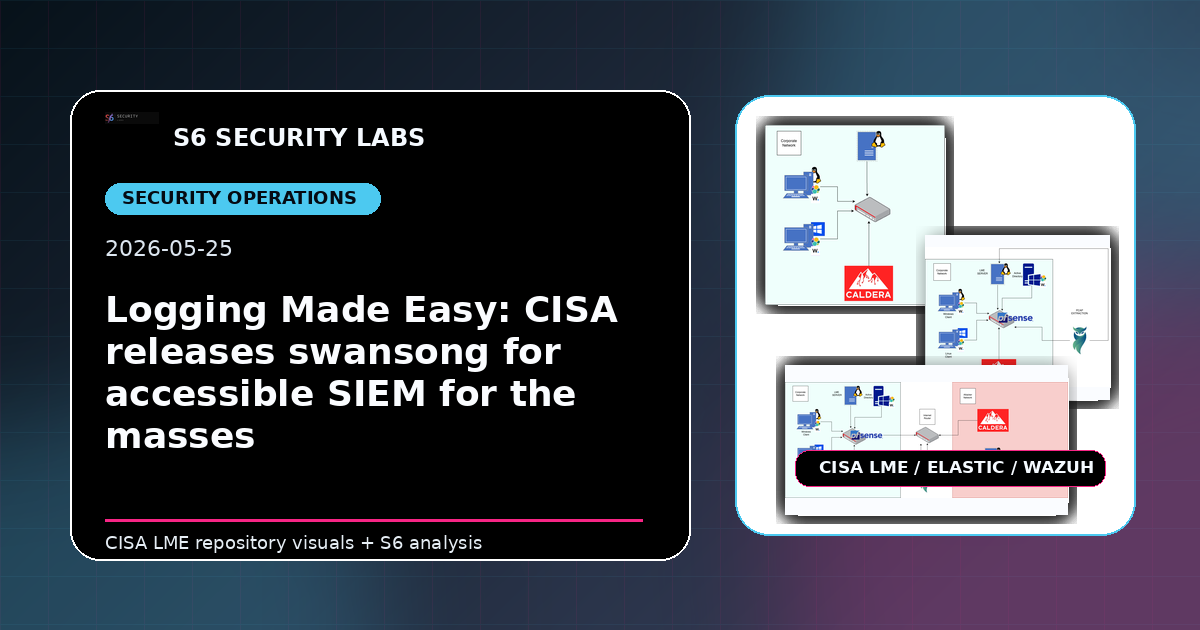
Logging Made Easy: CISA releases swansong for accessible SIEM for the masses
The SIEM market has trained security leaders to ask the wrong first question.
The usual question is: which Gartner-recognised SIEM should we buy?
The better question is: what security outcome do we need, how fast do we need it, and what else could our engineers do with the time and money not spent feeding a platform?
That is where CISA's Logging Made Easy, better known as LME, becomes interesting.
LME is not a toy SIEM. It is a no-cost log management and threat detection platform built from a mix of open-source, permissively licensed, and source-available components including Wazuh, Elastic, Kibana, ElastAlert2, endpoint agents, dashboards, Ansible automation, and containerised deployment. It centralises logs, supports endpoint telemetry, enables search and visualisation, and provides real-time alerting.
The unfortunate part is that LME's biggest problem is not that it is free. Free is not the weakness. The weakness is that part of the stack sits behind licensing that makes a clean managed-service or resale model difficult. Elastic License 2.0 permits broad use, copying, distribution, and modification, but it prohibits providing the software to third parties as a hosted or managed service where users receive access to a substantial set of Elastic's features. That matters. A customer can use LME internally. A partner can usually help deploy and tune a customer-controlled environment, subject to proper legal review. But an MSSP cannot simply repackage LME as "our hosted SIEM" and sell Elastic/Kibana-backed access at scale without colliding with the licence.
That is a shame, because the stack is close to the thing many organisations actually need: quick visibility, local control, practical alerting, and enough openness for real detection engineering.
It also attacks the part of SIEM adoption that rarely appears honestly in vendor slides: the time before the platform becomes useful.
In a suitable environment, a capable pair of engineers can stand up the core LME stack in roughly an hour or two. A production deployment still needs hardening, identity, storage sizing, backup, alert routing, monitoring, documentation, and operational handover. Reality has a habit of charging interest. But the starting point is materially different from the traditional SIEM programme where 50 to 100 hours can disappear before useful visibility arrives.
For many small and mid-sized organisations, that difference is the difference between "we should improve logging this quarter" and "we have searchable endpoint and server telemetry today".
What LME Already Delivers
LME provides the foundations most organisations actually need before they can claim to operate a SOC:
- Windows and Linux log collection
- endpoint/security monitoring through Wazuh and agents
- search and investigation through Elastic
- dashboards and visualisation through Kibana
- real-time alerting through ElastAlert2
- repeatable deployment through Ansible
- containerised services through Podman
- local control of telemetry
- custom detection rules and dashboards
- no per-GB commercial SIEM licence tax
Recent LME updates also improved deployment and operational practicality, including broader Linux support, air-gapped/offline installation support, SELinux improvements, better documentation, improved single-node index defaults, and cleaner deployment workflows.
None of that makes LME a complete enterprise SOC platform. It does not magically replace mature case management, full SOAR, global vendor support, managed detection content, compliance packs, executive reporting, contractual SLAs, or deep ecosystem integrations.
But most organisations do not fail because they are missing the final 5% of enterprise polish.
They fail because they have no useful telemetry, no central search, weak endpoint visibility, noisy alerting, and no repeatable detection workflow.
LME addresses that problem directly.
Repository Visuals from CISA LME
The CISA LME repository is useful because it shows the project as an operating model, not just a download link. The detection engineering material makes the same point this article is arguing: the value is not merely collecting logs. The value is turning telemetry into repeatable investigation and detection work.
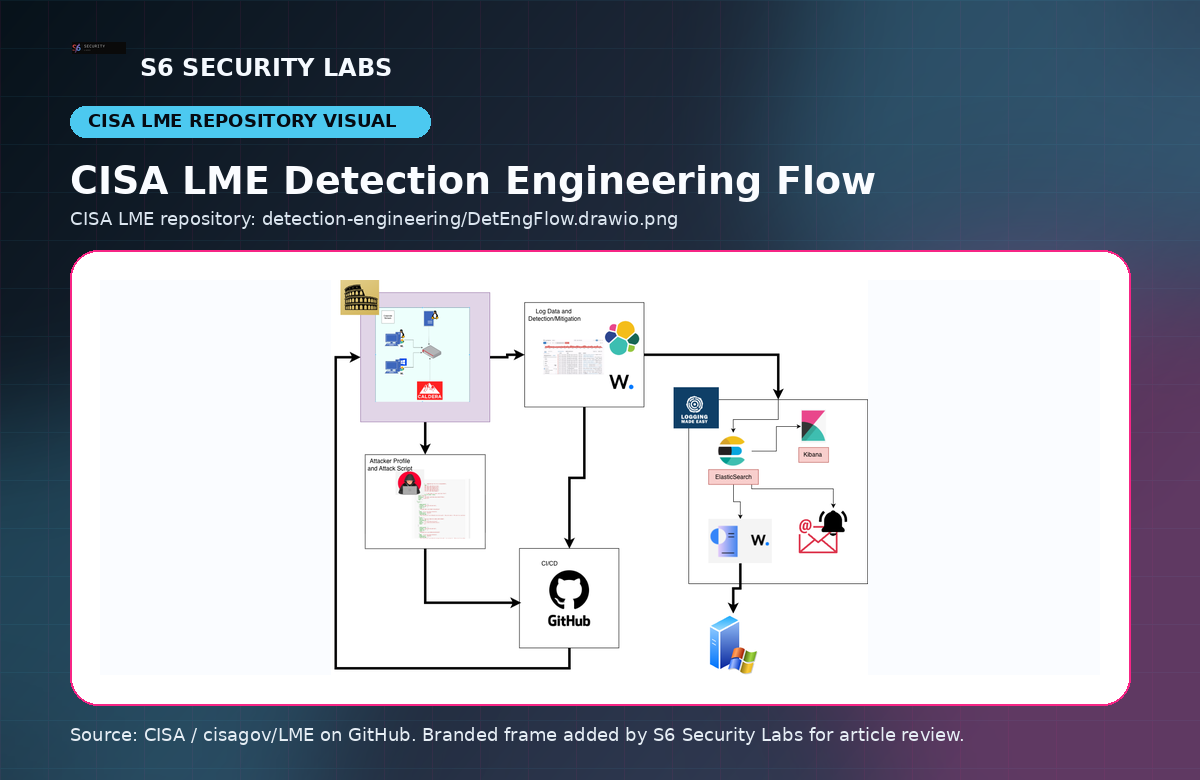
Source image: CISA LME GitHub repository, detection-engineering/DetEngFlow.drawio.png. S6 added the branded frame for article presentation.
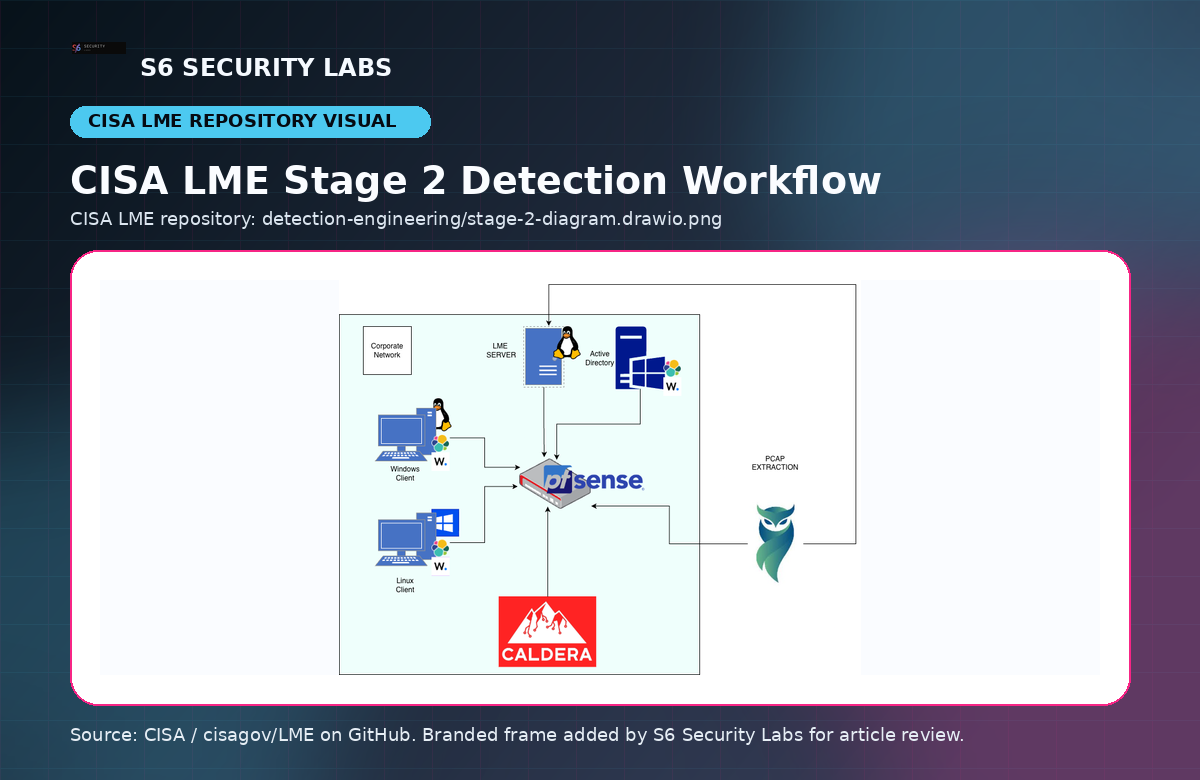
Source image: CISA LME GitHub repository, detection-engineering/stage-2-diagram.drawio.png. S6 added the branded frame for article presentation.
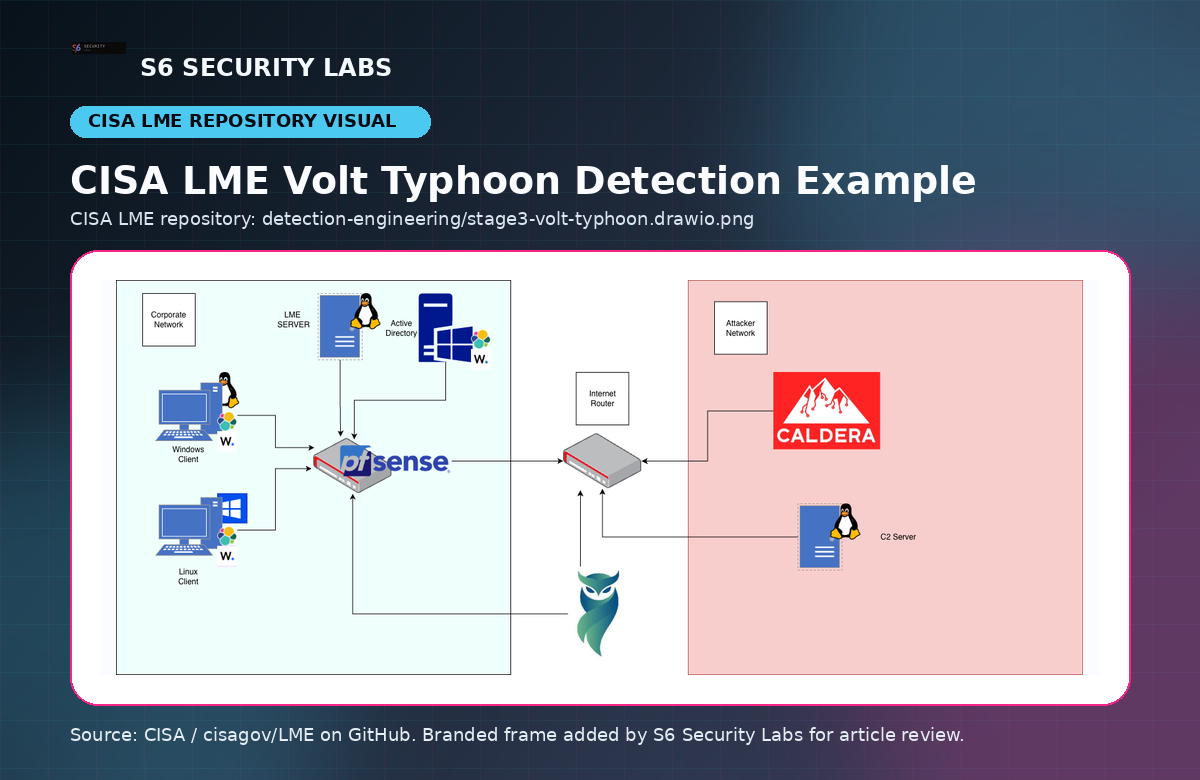
Source image: CISA LME GitHub repository, detection-engineering/stage3-volt-typhoon.drawio.png. S6 added the branded frame for article presentation.
The AI Layer Changes the Value Proposition
The bigger opportunity is not LME by itself. It is LME as the telemetry and detection layer underneath an AI-assisted SOC workflow.
An AI layer can sit beside the stack and accelerate the work that normally consumes analyst and engineering time:
- Natural-language investigation: ask for failed logons followed by privilege changes, suspicious PowerShell, or unusual host activity without forcing every analyst to remember query syntax.
- Alert triage: summarise why an alert fired, what user/host/process is involved, and which evidence supports escalation.
- Detection engineering support: convert threat hypotheses into Wazuh, Sigma-style, or ElastAlert logic, explain likely false positives, and generate test cases.
- Entity summaries: explain what changed for a host, user, IP, process, or authentication pattern.
- MITRE ATT&CK mapping: connect observed events and rules to common adversary behaviours.
- Playbook drafting: turn recurring alerts into response checklists and handover notes.
- Case summaries: produce clean incident notes for tickets, management reporting, and post-incident review.
- Log explanation: explain Windows Event IDs, Sysmon events, Linux auth logs, Wazuh alerts, and Elastic fields in plain language.
- Weekly reporting: summarise top alerts, coverage gaps, noisy rules, newly onboarded sources, and recommended tuning work.
This is not a claim that AI replaces analysts. It should not. That would be vendor theatre, and security has enough of that stocked for winter.
The useful model is simpler:
- LME collects, stores, searches, alerts, and visualises.
- The AI layer summarises, explains, drafts, correlates, and accelerates.
- Security engineers validate, tune, respond, and improve the environment.
That combination can deliver a very large percentage of the practical SIEM outcome for organisations that currently have limited monitoring maturity.
A fair estimate: LME plus a well-scoped AI/SOC workflow can deliver 80 to 95% of what many organisations actually use from a SIEM out of the box.
Not 95% of every enterprise SIEM feature. That would be nonsense. But 95% of the day-one operational value many teams need: collect the important logs, search them, alert on known patterns, understand what happened, and respond faster.
Feature Comparison: LME vs Common Commercial SIEM Options
The table below is deliberately practical. It compares operational outcomes, not just procurement brochure features. It also separates "can technically be made to work" from "sensible default architecture". That distinction matters. A platform that can be dragged into a restricted environment with enough gateways, exceptions, and professional services is not the same thing as a platform designed for local operation.
| Capability | LME + AI-assisted workflow | Splunk Enterprise Security | Microsoft Sentinel | Palo Alto Cortex XSIAM |
|---|---|---|---|---|
| Core SIEM log collection | Strong baseline for Windows/Linux endpoints and common infrastructure sources; extensible through Elastic/Wazuh pipelines, but not as connector-rich as the commercial leaders. | Very strong; broad ingestion ecosystem and mature forwarders. | Very strong in Azure/Microsoft environments; broad connector ecosystem. | Strong, especially when combined with Palo Alto/XDR telemetry. |
| Endpoint telemetry | Moderate to strong for logging, FIM, vulnerability/configuration signals, and endpoint security events through Wazuh/Elastic agents. Not a like-for-like EDR replacement. | Strong when paired with Splunk-supported EDR sources; Splunk itself is not the endpoint sensor. | Very strong when paired with Microsoft Defender. Sentinel itself is the SIEM layer, not the endpoint sensor. | Very strong; endpoint/XDR is central to the platform. |
| Search and investigation | Strong through Elastic/Kibana for teams comfortable owning Elastic. AI layer can reduce query burden. | Excellent; SPL remains one of Splunk's main strengths. | Strong through KQL and Log Analytics. | Strong, with platform-led investigation workflows. |
| Dashboards and visualisation | Strong through Kibana; requires engineering ownership. | Excellent, mature, highly customisable. | Strong, especially with Azure workbooks and Microsoft content. | Strong for security operations views; less open-ended than Splunk/Elastic. |
| Detection content out of the box | Moderate baseline via Wazuh/ElastAlert. Useful quickly, but real value depends on local tuning, source onboarding, and detection engineering. | Strong with Enterprise Security content and community/vendor add-ons. | Strong with Microsoft analytics rules, templates, and Defender integration. | Strong, especially in Cortex-native/XDR workflows. |
| AI-assisted triage | Not inherent to LME, but highly achievable with an added local or API-based AI layer. | Available through Splunk AI/product features and custom integrations, but not the historical default ES experience. | Strong if using Microsoft Security Copilot and related services; this is an additional platform/service decision, not just base Sentinel. | Strong emphasis on automation and AI-driven SOC workflows, assuming the organisation adopts the Cortex operating model. |
| Detection engineering flexibility | High at the stack level. Open rules, local pipelines, and modifiable deployment, but teams own quality control and lifecycle. | High. SPL is powerful and portable within Splunk, but skills and content are Splunk-specific. | High for KQL/Microsoft-cloud-centric teams; lower if the environment is mostly non-Microsoft or disconnected. | Moderate to high, but more platform-prescribed and dependent on Cortex data models/workflows. |
| SOAR and response automation | Limited out of the box; can integrate with scripts, ticketing, webhooks, and external automation. | Strong with Splunk SOAR or integrations. | Strong through Logic Apps and Microsoft ecosystem. | Strong; automation is a major platform proposition. |
| Case management | Basic unless integrated with ticketing or custom workflow. | Strong in Enterprise Security workflows and add-ons. | Strong when integrated with Defender/Sentinel incidents. | Strong platform-native case/incident workflows. |
| Compliance reporting | Possible, but must be built and maintained. | Strong with mature apps and reporting. | Strong for Microsoft/Azure compliance contexts. | Strong for enterprise SOC/XDR reporting. |
| Air-gapped or restricted environments | Good fit. LME has offline installation support and local data control, though updates and package lifecycle still need a managed process. | Good with self-managed Splunk Enterprise/ES. Splunk Cloud and cloud-connected features are a different story. | Effectively no for true air-gapped environments. Sentinel is Azure-native and depends on cloud control plane, ingestion, analytics, and service availability. | Poor fit for true air gap. Cortex XSIAM is a cloud-delivered/XDR-centric platform; restricted environments need careful vendor-specific validation. |
| Data residency and local control | Very strong. Operates locally if designed that way. | Very strong self-managed; Splunk Cloud shifts data into Splunk-managed cloud regions. | Azure-region based, with Microsoft service/control-plane dependency. Good regional options, not local control. | Vendor-platform dependent; generally cloud/platform aligned rather than locally controlled. |
| Scaling to very large enterprises | Possible, but engineering-heavy and not the default sweet spot. Large scale requires serious Elastic/storage/operations capability. | Excellent when funded and engineered properly. | Excellent in Azure-scale environments. | Excellent for organisations adopting the full Cortex model. |
| Implementation speed | Very fast for baseline capability; production hardening, alert routing, backups, and lifecycle ownership still required. | Moderate. Fast for experienced Splunk teams, slower when CIM, ES data models, source onboarding, governance, and cost controls are new. | Fast for Microsoft-native sources; broader hybrid/on-prem environments take connector, agent, and architecture work. | Moderate. Value improves when the organisation standardises endpoint, network, cloud, and SOC workflows around Cortex. |
| Commercial support/SLA | No CISA support after retirement; support must come from internal team, community, or a partner. A partner-supported customer deployment is very different from a hosted/resold LME SIEM service. | Strong vendor/partner support ecosystem. | Strong Microsoft support ecosystem. | Strong Palo Alto support ecosystem. |
| MSSP resale / hosted managed service | Constrained. LME's own code is permissive, but Elastic/Kibana under Elastic License 2.0 blocks providing a substantial set of Elastic features to third parties as a hosted or managed service. Customer-owned deployments and advisory/tuning services are a different, reviewable model. | Commercially available through approved licensing and partner/MSP arrangements. | Commercially available through Microsoft/customer tenant and partner arrangements. | Commercially available through Palo Alto/partner arrangements. |
| Licence cost exposure | No LME licence fee; costs are infrastructure, storage, engineering, support, and optional AI. | Medium to high. Cost commonly tied to ingest/workload/platform entitlements and premium security features; strong discounting and self-managed options can change the shape. | Medium to high. Consumption model tied to ingestion, analytics, retention, and Azure services. | High. Enterprise commercial model tied to endpoint/XDR/SOC platform adoption. |
| Vendor lock-in | Low to moderate. Open stack, but Elastic/Wazuh component choices still matter. | Medium to high. Data can be exported and self-managed deployments reduce some dependency, but SPL, apps, CIM/data models, dashboards, and skills create real gravity. | High if the organisation standardises on Azure, KQL, Defender, Logic Apps, and Microsoft incident workflows. | High if the SOC standardises on Cortex workflows, endpoint telemetry, automation, and case handling. |
The Licensing Difference
The licensing model is one of LME's strongest economic arguments, but it needs to be described carefully.
It is also the biggest structural problem with the model.
Not because LME is free. That part is good. The problem is that a stack can be free for internal use and still awkward to commercialise. Many organisations do not want to become SIEM engineers. They want a managed security provider to bring a working platform, tune it, operate it, and take accountability for the outcome. That is exactly where the Elastic licensing constraint becomes material.
LME itself uses a permissive structure:
- US government-developed portions are distributed under Creative Commons Zero (CC0).
- Other/new submissions are generally under Apache License 2.0.
- Wazuh is GPLv2.
- ElastAlert2 is Apache License 2.0.
- Elastic/Kibana components are under Elastic License 2.0, which allows broad use, copying, distribution, and modification, but restricts providing the software to third parties as a hosted or managed service that exposes a substantial set of Elastic features.
For internal use, this is dramatically more flexible than proprietary SIEM licensing. Organisations can deploy LME, modify it, operate it locally, build local workflows, and avoid per-GB SIEM licence growth.
For commercial managed-service use, the component licences matter far more. Anyone building an LME-based MSSP or hosted SIEM offer needs legal and architecture review, especially around Elastic License 2.0 and Wazuh GPL obligations. The safest reading is that you should not assume you can resell a hosted LME SIEM that exposes Elastic/Kibana functionality to customers. Selling implementation, tuning, detection engineering, and operational support around a customer-controlled deployment is a more plausible model, but still needs proper review rather than a blog-post blessing. Annoying, but law has rarely been improved by vibes.
This is the central frustration: the technical stack is compelling, but the licence shape makes it harder for service providers to productise it for the exact organisations that need help most. Anyone who has built a SIEM knows the hard part is not merely installing software. It is the source onboarding, normalisation, noisy-rule suppression, escalation logic, dashboards, retention design, access control, backup process, and steady tuning required before the system is trusted in a medium or large environment. That is where a good MSSP could add enormous value. The current licensing mix makes that route narrower than it should be.
Compared with Splunk, Sentinel, or Cortex XSIAM, LME has far fewer restrictions around internal deployment and telemetry volume. The commercial platforms commonly restrict or price around some mix of:
- daily ingest volume
- endpoint count
- retained data volume
- analytics workloads
- user seats
- advanced detection packs
- SOAR functionality
- API usage
- support tier
- cloud region
- managed service or resale rights
- premium integrations
That does not make those platforms bad. It makes them commercial platforms. The meter is part of the architecture.
Pricing Estimates: Directional, Not a Quote
SIEM pricing is difficult to compare cleanly because vendors use different models, discounts, bundles, cloud credits, enterprise agreements, endpoint counts, storage tiers, and support structures. Anyone claiming a universal price without assumptions is selling confidence, not accuracy.
The table below uses directional annual estimates for planning only. It assumes the organisation is collecting security-relevant telemetry at common mid-market volumes and wants enough capability for real SOC use, not a lab demo.
| Scenario | LME-based stack | Microsoft Sentinel-style consumption SIEM | Splunk Enterprise Security-style deployment | Cortex XSIAM-style platform |
|---|---|---|---|---|
| 25 GB/day | US$5k-50k first year, mostly infrastructure, storage, support, and engineering. | US$23k-73k/year before all optional retention, support, and implementation costs. | Often US$50k-150k+/year once platform/security features and support are included. | Usually quote-driven; may be unattractive unless endpoint/XDR consolidation is also in scope. |
| 50 GB/day | US$10k-75k first year depending hardening, retention, and support model. | US$46k-146k/year directional platform consumption range. | Often US$100k-300k+/year depending ingest/workload model and Enterprise Security scope. | Quote-driven; can make sense when replacing multiple SOC/XDR tools, not just buying SIEM. |
| 100 GB/day | US$25k-125k first year; storage and engineering start to dominate. | US$91k-292k/year directional platform consumption range. | Often US$200k-600k+/year depending contract, retention, and security app requirements. | Likely enterprise quote; endpoint count and platform consolidation drive economics. |
| 250 GB/day | US$75k-250k+ first year if engineered properly; still mostly controllable internal/partner cost. | US$228k-730k/year directional platform consumption range. | Often US$500k-1.5m+/year in larger enterprise/security deployments. | Enterprise quote; may be justified if replacing SIEM, EDR, automation, and SOC workflow tooling. |
Those numbers are approximate, but the pattern is the point.
With commercial SIEM, log volume becomes a recurring commercial event. Every new source, verbose endpoint, DNS feed, proxy log, cloud audit trail, or detection idea has a cost conversation attached.
With LME, the direct licence meter is removed. The money does not disappear; it moves. It becomes infrastructure, storage, engineering, support, tuning, and AI workflow cost.
That can be a better trade.
The Opportunity Cost Nobody Puts in the SIEM Quote
A SIEM budget is not independent from engineering capacity.
Every hour spent procuring, implementing, integrating, feeding, tuning, and justifying the platform is an hour not spent reducing risk elsewhere.
If LME compresses the first useful deployment from 50-100 hours to a few hours or days, the saved time can go into work that often reduces risk more directly:
- hardening Active Directory
- improving privileged access hygiene
- removing stale admin accounts
- deploying Sysmon properly
- closing exposed management interfaces
- fixing firewall segmentation
- building detections that match the environment
- testing incident response playbooks
- improving backup resilience
- onboarding missing log sources
- tuning alerts until humans can tolerate them
- documenting actual escalation paths
- automating evidence collection
- running tabletop exercises
This is the real economic argument.
A traditional SIEM purchase may buy a powerful platform but consume the same people needed to make the environment safer. LME gives those people a faster path to baseline visibility, then lets them spend more of their time on security engineering instead of platform worship.
What LME Does Not Solve
The argument for LME should not be oversold.
LME does not remove the need for:
- security engineering judgement
- detection tuning
- log source onboarding
- storage planning
- backup and restore testing
- access control and secrets management
- alert routing and escalation design
- patching and lifecycle management
- compliance mapping
- incident response process
- ownership after CISA support retires
It also does not automatically replace a commercial SIEM for highly regulated, global, or very large environments that need contractual support, deep integrations, mature SOAR, audit-ready reporting, and enterprise-scale resilience.
But that is not the majority of organisations starting from weak logging maturity.
For them, the question is not whether LME beats Splunk, Sentinel, or Cortex XSIAM in a feature matrix.
The question is whether LME plus an AI-assisted SOC workflow delivers enough practical SIEM capability quickly enough that scarce engineers can spend the remaining time reducing actual risk.
For many organisations, the answer will be yes.
The Bottom Line
LME proves there is a serious middle ground between no SIEM and an expensive enterprise SIEM programme.
Add an AI-assisted investigation, triage, and detection-engineering layer, and the model becomes even more compelling: local telemetry, fast deployment, open modification, practical alerting, analyst acceleration, and no per-GB SIEM licence tax.
The Gartner leaders still have their place. Large enterprises with complex compliance, mature SOC processes, and existing platform commitments may get value from Splunk, Sentinel, Cortex XSIAM, or similar products.
But for many organisations, especially those with limited budget and thin security teams, the better first move may be different:
Deploy the visibility layer quickly. Use AI to reduce the analyst burden. Spend the saved hundreds of hours fixing the environment.
That is not a cheaper SIEM story.
That is a better security economics story.
Sources
- CISA Logging Made Easy: https://www.cisa.gov/resources-tools/services/logging-made-easy
- LME GitHub repository: https://github.com/cisagov/LME
- LME documentation: https://cisagov.github.io/lme-docs/
- LME licence file: https://github.com/cisagov/LME/blob/main/LICENSE
- Elastic License 2.0: https://www.elastic.co/licensing/elastic-license
- Wazuh licence: https://github.com/wazuh/wazuh/blob/master/LICENSE